

Read time: 4 minutes | Unlock my Claude Skills Bundle
Hey friend, Alex here.
I reviewed a client’s launch plan last month. Twelve pages, tight formatting, every section backed by competitor research. Their pricing was $49/month. Why $49? Because their two biggest competitors charge $47 and $52. Their launch channel was LinkedIn ads. Why LinkedIn? Because “everyone in their industry runs LinkedIn ads.” Their onboarding flow was a 7-day email sequence. Why 7 days? Because a SaaS playbook from 2019 recommended it.
Nothing in the plan was wrong. But nothing in it was theirs, either. Every decision had been borrowed from somebody else’s context and dropped into a new one without checking whether the reasoning still applied.
This is what happens to most plans. They accumulate assumptions from blog posts, competitor moves, and “best practices” that were someone else’s solution to someone else’s problem. Then you paste the plan into Claude, Claude polishes it, and now you have a beautifully optimized strategy built on foundations nobody ever examined.
Today:
A copy-paste prompt that strips any plan down to its load-bearing assumptions and sorts them into verified truths, inherited conventions, and untested guesses
Real results from 3 client scenarios: 40 assumptions extracted, only 9 held up as verified truths
3 free resources worth bookmarking this week, including a decision-making thread
⚡ THE SUPERPOWER: Going Back to First Principles
Everyone mentions first principles thinking. Elon Musk brings it up in interviews. Business Twitter treats it like a secret weapon. But most people who reference it couldn’t name an actual first principle if you asked.
A first principle is a foundational truth you can verify on your own, without referencing what competitors do or what a blog post recommended. Aristotle called it “the first basis from which a thing is known,” over 2,300 years ago. In physics, conservation of energy is one: energy transfers but never appears from nothing. In economics: a transaction only happens when both sides believe they’re gaining more value than they’re giving up. In business: revenue must eventually exceed costs, or the company dies. These sound obvious when you say them out loud. That’s the point. First principles are supposed to be obvious. The problem is everything piled on top of them.
Take pricing. “Charge $49/month” is not a first principle. It’s a convention borrowed from competitors. The first principle underneath it is: the price has to reflect the value delivered, or customers leave. The convention might be right. But it was never tested for this specific product, this specific audience, this specific value prop. And when you paste your pricing plan into Claude and ask it to improve, Claude optimizes the $49 without ever questioning whether $49 was the right starting point.
The most expensive part of any plan is the assumption you never noticed was an assumption.
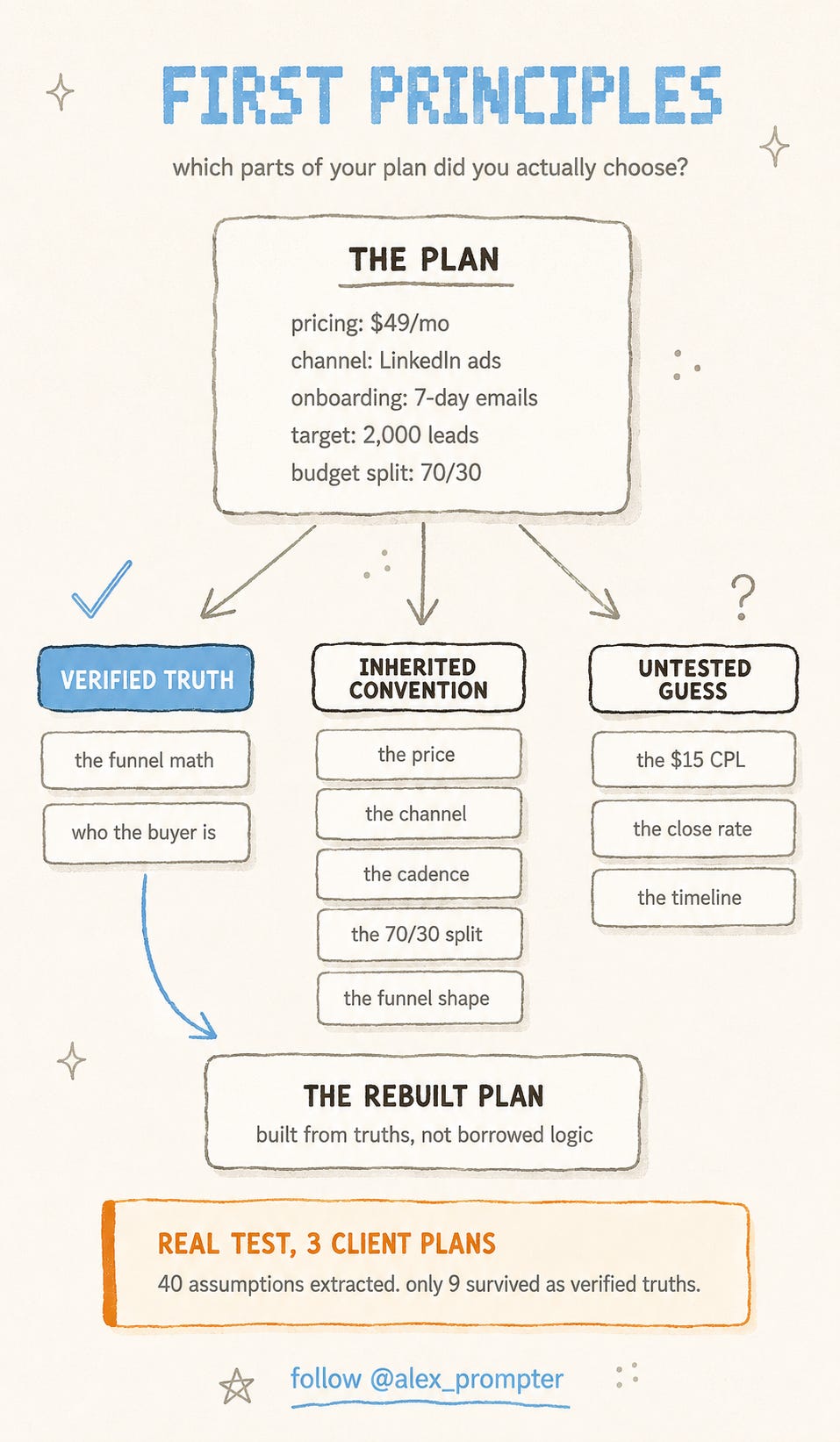
I ran this across 3 client plans last month. The prompt pulled 40 assumptions out of strategies that looked airtight on paper. Only 9 held up as verified truths. The rest were borrowed.
⚙️ THE WORKFLOW
So I built a prompt that does the sorting for you. You give it any plan, strategy, or decision you’re about to commit time or money to, and it pulls out every assumption holding the plan together, classifies each one, and rebuilds a clean version from only the parts you can actually defend.
Open a fresh Claude chat (free tier works) and paste this:
You are a First Principles Analyst.

I will share a plan, strategy, or decision. Your job:

1. EXTRACT every assumption this plan rests on. List each as a single, testable statement. Find at least 8.

2. SORT each assumption into exactly one bucket:

   VERIFIED TRUTH: A foundational fact you can confirm independently, without referencing competitors, past experience, or external advice. State why it qualifies.

   INHERITED CONVENTION: Something done because others do it, because it worked elsewhere, or because "that's how it's done." Name the likely source it was inherited from.

   UNTESTED GUESS: An assumption that might be true but has never been validated in this specific context. State what would need to be true for it to hold.

3. REBUILD the plan using only the Verified Truths. Show what changes when conventions and guesses are removed.

4. CHALLENGE LIST: For each convention and guess, write one question the user should answer before keeping it.

Be rigorous. Most plans are 80%+ inherited logic. If your sort returns mostly Verified Truths, you are being too generous.
Once you get the response:
Read the Inherited Convention bucket first. These are the assumptions you never chose. Count them.
Pick the one that surprised you most and ask yourself: would I choose this today if I were starting from zero?
Check the Rebuild section. The stripped-down version often looks nothing like the original. That gap tells you how much of your plan was actually yours.
Use the Challenge List as homework. Each question points to a specific piece of information you need before you can confidently keep that assumption in the plan.
The best time to run this is right before you commit resources: before you finalize a budget, sign off on a strategy, or lock in a pricing structure. Any moment where you catch yourself thinking “because that’s how it’s done” is a signal to paste the plan and sort.
Here are the full numbers. I ran this across 3 client scenarios last month: a B2B paid social campaign, an influencer product launch, and a 6-month SEO growth plan. Across all three, the prompt extracted 40 total assumptions. Nine qualified as verified truths, about 22%. Seventeen were inherited conventions, things done because a competitor does them or an industry playbook said so. Fourteen were untested guesses dressed up as data. The SEO plan was the most striking: the prompt did the client’s own funnel math and found that if the plan actually hit its targets, it would produce 400 new advisory clients per month. Nobody had run the arithmetic on what “success” actually meant, and the plan’s own numbers described an outcome the business couldn’t operationally survive.
Fair warning: the prompt’s instinct is to strip everything borrowed and start clean, but some conventions are conventions because they work. After you get the sort, go back to the inherited bucket and ask “does this one hold up for my specific context?” before you cut it.
Want to go deeper? I put together a short PDF guide that walks you through turning this prompt into a permanent Claude skill. Install it once, and every new conversation in your project gets the First Principles analysis without re-pasting anything.

💬 PROMPT OF THE DAY
I have ADHD and I need to [describe your task]. Don't give me a full plan. Give me ONE next step that takes under 5 minutes. When I come back and say "done," give me the next one. Keep going until the task is complete.Why it works: it prevents the overwhelm of seeing a full task list by turning the model into a step-by-step pacer. Each step is small enough to start without willpower, and coming back for the next one creates its own momentum.
Best on: any model.
📚 USEFUL RESOURCES
🧠 The Principles of Better Decisions (X thread, 7 mental models) → the thread that inspired this series; first principles is one of seven frameworks worth bookmarking (free: here )
📖 Farnam Street: First Principles (the definitive mental-model guide) → Shane Parrish’s full breakdown, with the Musk and Feynman examples worth stealing (free: fs.blog/first-principles)
✍️ James Clear: First Principles (the most readable intro) → Musk’s rocket-cost story plus how to actually apply the method (free: jamesclear.com/first-principles)
What should next week’s superpower be: a tool-specific workflow or another decision-making framework? Hit reply, one word is enough.
Know someone running a strategy built entirely on “because that’s how it’s done”? Forward them this.
And as always, remember: LLMs don’t think, you do.
⚡ Alex Prompter
P.S. Today’s First Principles prompt is one workflow. My Claude Skills Bundle turns Claude into 20+ specialists for marketing and business. Grab yours here: linktr.ee/alex_prompter
AI Superpowers, part of the Alex Prompter network. One new AI superpower every Tuesday, under 5 minutes.