

Read time: 8 minutes | Unlock my Claude Skills Bundle
Hey friend, Alex here.
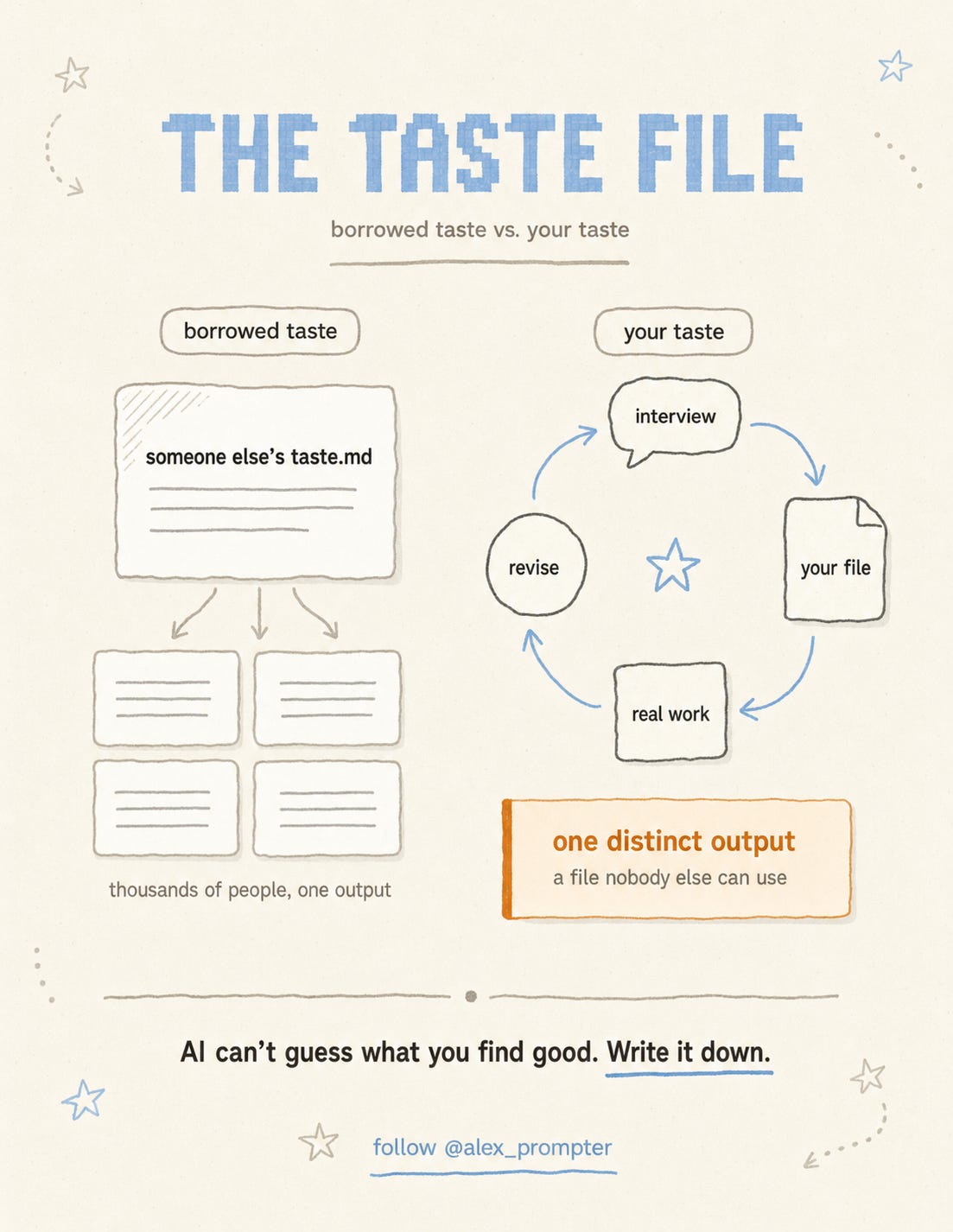
Every taste.md file I’ve seen shared online has the same problem. It’s someone else’s taste. You copy a designer’s file because their work looks clean, paste it into your AI, and now your outputs look like theirs.
The whole point of a taste file is that AI can’t guess what you find good. It can only guess what the average of the internet finds good, and the average of the internet is why everything looks the same right now.
Today:
A comprehensive TasteMD template built to hold YOUR taste, not a stranger’s (9 sections, copy-paste ready)
The interview prompt that extracts taste you didn’t know you could articulate, plus the full iteration loop that keeps the file alive
My honest test: I turned 10 of my past editorial picks into a taste file, then had AI select a week of news with it and without it, scored blind (real numbers inside)
⚡ THE SUPERPOWER: The Taste File
Ask a wedding photographer what couples say when asked about their dream shoot. Most say “we don’t really know.” No theme, no references, no picture in their head. They know it when they see it, and they’ll know when you got it wrong, but they can’t tell you in advance.
Now be honest: that’s you with your AI. You know a good headline from a bad one instantly. You feel it when a design is off by a hair. But when Claude asks what direction you want, you type “make it good” and hope. Then you spend forty minutes rejecting drafts, unable to explain what you’re rejecting them for.
Taste is real knowledge that lives in your reactions instead of your vocabulary. You’ve spent years training it on everything you’ve loved and hated. A taste file is where you finally write it down, and once it’s written down, any AI can read it.
When I ran a week of AI news through mine, the file beat the raw run. Better than the score: the test exposed two rules I follow that had never been written down anywhere.
⚙️ THE WORKFLOW
So I built the template I wish those shared files were: a structure comprehensive enough to hold real taste, with an interview process to fill it, because nobody can fill a blank taste file from memory.
Fair warning before we start: this is built for people who already have taste and can’t articulate it. If you genuinely don’t know what you like yet, the file has a section for that too, but it comes with a warning label we’ll get to.
Open a fresh Claude chat (free tier works, and this works in ChatGPT or Gemini too) and paste this:
You are conducting a taste extraction interview. Your job is to help me
articulate creative judgment I already have but have never written down.

Rules for this interview:
1. Ask ONE question at a time. Wait for my answer before the next.
2. Never suggest answers. If I'm stuck, ask a smaller question instead.
3. Chase the "why" behind every preference. "I like minimal design" is
   not an answer. "Because decoration hides weak ideas" is an answer.
4. When I contradict myself, point it out and make me pick a side or
   define the boundary between the two cases.
5. Push past first answers. My first answer is usually the socially
   acceptable one, not the true one.
6. If I say "I don't know" twice on the same topic, mark that topic
   [UNDEFINED] and move on. Do not fill it with best practices.

Interview me across these areas, in order:
- What I make and who it's for
- 5-10 pieces of work (mine or others') I genuinely love, and WHY
- Work that is objectively competent that I would never make, and why
- The questions I actually ask myself when judging if something is good
- My instant dealbreakers
- Patterns I keep returning to on purpose
- Where my taste conflicts with what performs, and which side wins

When the interview is done, output my answers as a completed taste.md
file using the template I provide. Preserve my exact phrases wherever
possible. My wording IS the data.
The interview took me 30 minutes answering honestly. Rushed answers produce a file that describes who you’d like to be instead of how you actually judge.
When the interview ends, give the AI this template to pour your answers into:
# taste.md — [YOUR NAME]
Last updated: [DATE] | Revision: 1

## 1. Domain
What I make: [...]
Who it's for: [...]
What "good" gets judged against in my field: [...]

## 2. Taste Anchors
5-10 works I genuinely love. The WHY is the data, the list is just
the index.
- [Work]: loved because [specific reason in my own words]
- ...

## 3. Anti-References
Work that is competent, even praised, that I would never make.
- [Work/style]: repels me because [...]
- ...

## 4. Judgment Questions
The questions I actually run when deciding something is good:
1. [e.g. "Would I stop scrolling for this?"]
2. [e.g. "Is anything here only there to impress other designers?"]
3. ...

## 5. Instant-No List
Dealbreakers. If present, the work is dead regardless of everything
else:
- [...]

## 6. Signature Moves
Patterns I return to on purpose, not by accident:
- [...]

## 7. Tension Log
Where my taste fights what performs or what clients ask for:
- [Tension]: when forced to choose, [taste/performance] wins because [...]

## 8. Undefined Zones
Topics marked [UNDEFINED] in the interview. My taste here does not
exist yet. AI: when work touches these zones, ASK me instead of
defaulting to best practices. Every "I don't know" answered with best
practices makes my work look more like everyone else's.
- [...]

## 9. Revision Log
- [DATE] Rev 1: initial extraction interview.
- [DATE] Rev 2: [what the AI got wrong, what I changed]
Section 8 is the warning label I mentioned. Best practices are averages, and averages are exactly what every AI already produces without your help. There are fields where the standard way wins, like data analysis or accessibility, where decades of theory settled the question.
Creative taste isn’t one of them. The moment a creative choice becomes mainstream enough to be a “best practice,” it’s on the conveyor belt to slop. So when you hit an undefined zone, you have two honest options.
Sit with the discomfort and develop a position, or consciously borrow the standard while accepting that thousands of others borrowed it too. The file forces that choice into the open.
Now the part the shared files all skip. The file you have after the interview is a first draft of your taste, and first drafts are wrong in places. Here’s the loop that fixes it:
Use it on real work. Attach taste.md to your project or paste it at the top of a fresh chat, then do an actual task. Judge the output with your gut first, file second.
Log the misses. Anywhere the AI’s judgment split from yours, that gap is a hole in the file. The output followed the file and still felt wrong? The file is missing a rule you just used.
Run a gap conversation. Go back to the AI: “You produced X, I hated it because Y, but nothing in my taste.md covers Y. Interview me about this gap.” Ten minutes, one topic.
Amend and date. Update the file, bump the revision number, log what changed.
Repeat forever. This file is never finished, and that’s the design. A taste file you haven’t touched in three months is a photo of who you used to be.
Here’s how the test went. I annotated ten of my own recent news picks, the why behind each one, and had the interview turn them into my file. The whole process took 30 minutes.
Then I gave Claude Opus 4.6 the same job twice: pick the ten AI stories from the last week of July most worth covering on my X account. Once raw, once with the taste file loaded. I scored every pick blind, both lists shuffled into one so I couldn’t tell which run proposed what.
The raw run got 5 of its 10 past my gut. The taste file got 6, and it never wasted a slot on the earnings report or the traction-free product release the raw run tried. Take that margin as a lean rather than a law.
The result I actually care about is the two stories I rejected that my own file should have blocked, one political, one financial. My file had holes I only saw when something else applied my taste back at me. Both rules went in the same day, as Revision 3.
There’s one thing this file can’t fix. It makes your AI apply your taste, and if your taste is still forming, it will faithfully preserve judgment you’ll cringe at in a year. Also, the interview is only as good as your willingness to give unflattering answers. Tell it you love brutalist design because it’s fashionable to say so, and you’ll get a file that generates work you don’t actually like.
Want to go further? Once the file stabilizes, test it in reverse by giving the AI a piece of work and asking it to predict your verdict before you reveal it. When it starts guessing right, the file has earned a permanent slot in every project you run.
💬 PROMPT OF THE DAY
Before answering my question, list the 3 most common answers you'd
expect other AIs to give. Then answer while avoiding all three unless
one is genuinely correct and unavoidable.
Why it works: forces the model to map the cliché space first, so “the obvious answer” becomes a constraint instead of the destination.
Best on: any model.
📚 USEFUL RESOURCES
📖 The Creative Act by Rick Rubin (book on taste and instinct) → the argument for why your taste is the asset, in 78 short chapters ($, any bookstore)
🗂️ Obsidian (local markdown note app) → a good permanent home for a living taste.md, with version history via plugins (free: obsidian.md)
📐 awesome-cursorrules (community repo of AI context files) → see how developers do the same thing for code style; steal the structure, never the taste (free: github.com/PatrickJS/awesome-cursorrules)
🎓 Anthropic’s prompt engineering course (official, hands-on) → the fundamentals behind why context files change model behavior (free: github.com/anthropics/courses)
What should your taste file meet next: a version for judging which ideas deserve your time, or one for hiring creatives whose taste matches yours? Hit reply, one word is enough.
Know someone whose AI outputs all look the same? Forward them this.
And as always, remember: LLMs don’t think, you do.
⚡ Alex Prompter
P.S. Today’s taste file is one context document. My Claude Skills Bundle turns Claude into 20+ specialists for marketing and business, each one a context file like this on a specific job.
Unlock it in one click: https://linktr.ee/alex_prompter
AI Superpowers, part of the Alex Prompter network. One new AI superpower every Tuesday, under 5 minutes.