

Read time: 5 minutes | Unlock my Claude Skills Bundle
Hey friend, Alex here.
For seven days my feed has been about one model, Jev, which came out of stealth last Monday, and one number, 445x, the claimed cost advantage over frontier models. By Wednesday I wanted to tell 200K people to go try it. I didn’t, and this issue is about why.
Last week I wrote that nobody in the “AI will kill us all” story is paid to de-escalate the fearmongering. This week the same problem runs in the opposite direction. Nobody in the Jev story is paid to tone down the hype. Every recommendation you read about it came from someone who gains if you believe it, and none of them disclosed what they gain. That includes me, and I’ll tell you what I gain before the end.
Today:
The Jev week in order, and the one question I asked every voice in it before deciding where I land
The Incentive X-Ray, a prompt that shows you who gains if you believe a recommendation and how much to discount it (copy-paste ready)
3 links worth keeping, including TypeSafe’s own launch post, which turned out to be more careful than the coverage of it
Chatbots were the easy part. Now AI has to work in the real world.
Grounded Intelligence covers the edge systems, distributed infrastructure, and technology behind intelligent systems that actually operate outside the chat window.

📰 WHAT HAPPENED LAST WEEK
Monday, 15 September. Diogo Almeida, whose work at OpenAI became the research behind ChatGPT, launched TypeSafe AI’s first model after two years in stealth, with a $40 million seed round led by DCVC. Jev doesn’t write text. You hand it a situation and a question, and it returns a decision with a probability attached, in 70 to 500 milliseconds. The launch post claimed 20 to 200x faster and 40 to 400x cheaper than frontier models. 39 million views and counting.

Tuesday to Thursday. Vercel wired Jev into its AI Gateway, one of its engineers posted that it beat their current safety classifier on an internal test, and on Thursday Vercel announced the fastest adoption of any model in Gateway history. TechCrunch ran the headline that developers are thrilled.
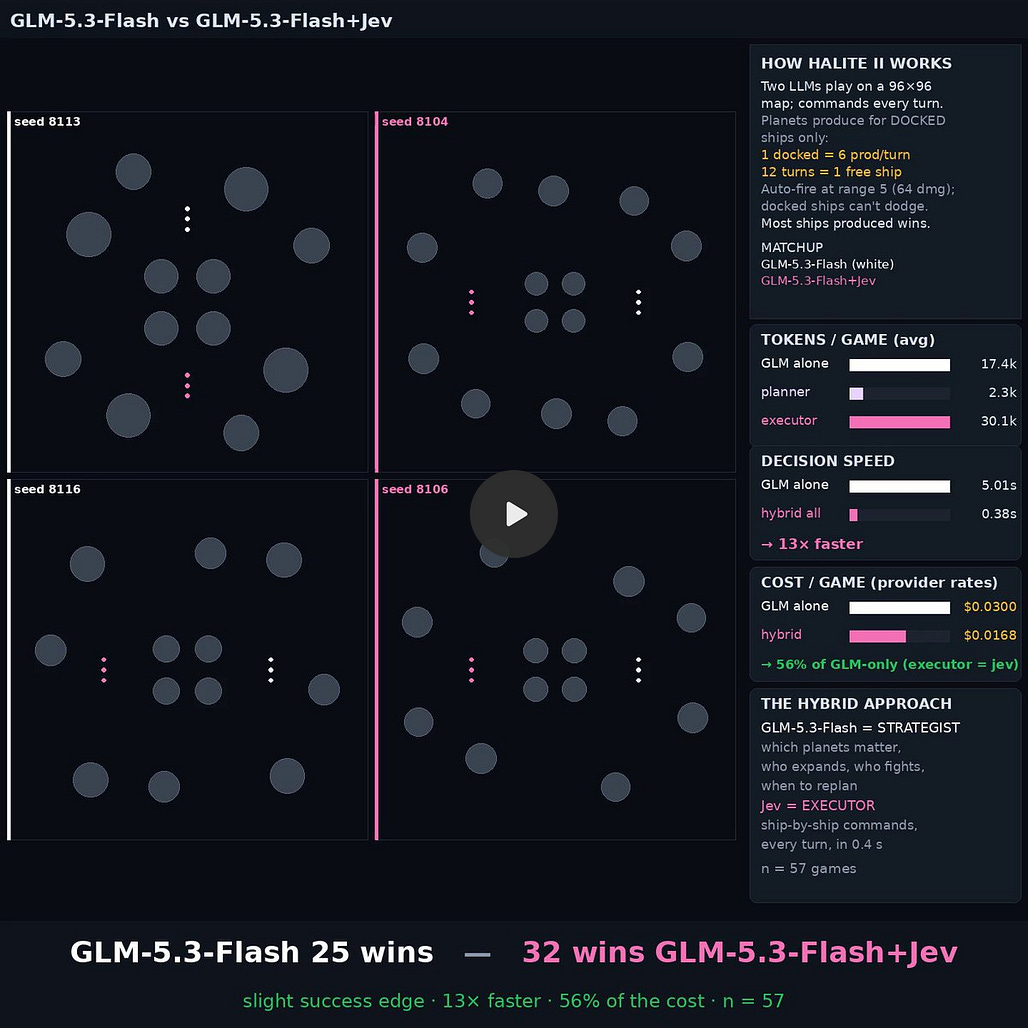
Friday to this morning. Vercel made Jev free on its Gateway until 25 September. TypeSafe dropped the waitlist on Saturday and gave every new account $5 in credit. On Sunday the API had an outage, and by Monday TypeSafe had paused new signups. One developer, Harrison Kinsley, posted the only comparison with a number against Jev. In his game-playing test, another model, GLM 5.3 Flash, beat Jev 82% of the time.


I asked one question of every voice in that timeline before deciding what I think, and it’s the same question the prompt below asks. What does this person gain if I believe them?
TypeSafe gains customers, and a fresh funding round needs adoption before competitors release similar models. Vercel gains traffic through its Gateway, and it measured its record-adoption chart during the week it was giving Jev away for free. The engineer behind the benchmark TechCrunch relayed works at Vercel. The trade sites gain a story with a ChatGPT-inventor angle, and most of them ran the company’s numbers without the company’s caveats. The skeptics, as far as I can find, gain nothing, and Kinsley’s result sits at 42,000 views next to Almeida’s 39 million.
Now the surprising part. The most careful document of the week came from TypeSafe itself. TypeSafe’s own blog says the 193.6x and 444.6x figures on its homepage are the high end of real-world gains, that its own team built the eval workflows so some bias could exist, and, in its own words, that it can’t prove the pricing isn’t subsidized. TypeSafe published its own caveats. The people amplifying TypeSafe left them out.
So, my decision. I’ll test Jev at the agency on jobs where a fast yes-or-no answer is enough, like sorting leads or routing support tickets. I won’t repeat the 445x number until someone outside TypeSafe reproduces it. And the next time a launch goes viral, I’ll read the company’s own caveats before I read the fans’ posts.
⚡ THE SUPERPOWER: The Incentive X-Ray
I did the work above by hand. You won’t do that for every launch, and there’s a new one every week. A recommendation from a seller reads the same as one from an independent tester, and the text alone won’t tell you which is which.
Every recommendation has an incentive behind it that you can’t see in the text, and that’s why nobody at TypeSafe or Vercel had to lie for the week to look the way it did. An incentive doesn’t make a claim false, it tells you how much to discount the claim before you act on it. The prompt below shows you the part you can’t see, which is the only reason it’s called an X-ray.
⚙️ THE WORKFLOW
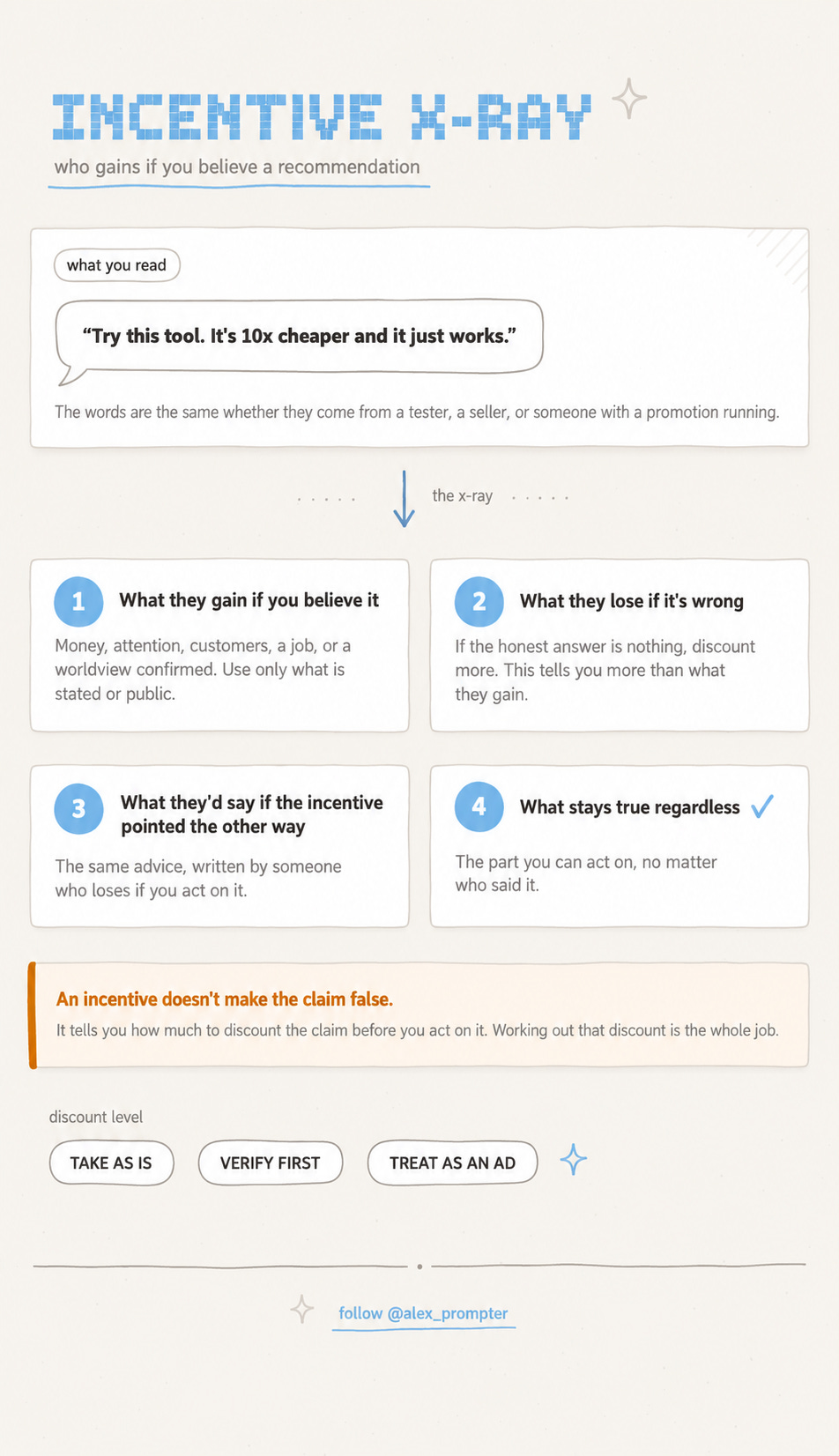
So I turned the question into a prompt. It takes a recommendation, who made it, and where it appeared, then returns four answers and a discount level. Open a fresh Claude chat, free tier works, paste this, and fill in the four brackets.
I want to know who gains if I believe a recommendation, so I can decide how much to discount it before I act.

Recommendation: [paste the post, article excerpt, or advice, word for word]
Who said it: [name, role, and company if known]
Where it appeared: [platform, and whether it was paid, sponsored, or part of a product launch, if you know]
My decision: [what I would do if I took the advice at face value]

Do this:
1. Name what the source gains if I believe them. Money, attention, customers, a job, a worldview confirmed. Use only what is stated or public. If you have to guess, write "unverified guess" in front of it.
2. Name what the source loses if the advice turns out wrong. If the answer is nothing, say so, because that changes the discount.
3. Write the version of this advice the same source would give if their incentive pointed the other way. Two sentences.
4. Name what stays true about the advice regardless of the incentive. This is the part I can act on.
5. Give a discount level: TAKE AS IS, VERIFY FIRST, or TREAT AS AN AD. One line on why.
6. Name one fact that, if true, would make the advice hold even with the incentive, and tell me how to check it in under 10 minutes.

Rules: an incentive does not make advice wrong. Do not call anyone dishonest. Keep it under 250 words.
Then do four things with the answer.
Paste the most-viewed version. Run the post with the most views, not the most careful one.
Read step 2 before step 1. What a source loses if they’re wrong tells you more than what they gain.
Act on step 4 only. The part that survives the incentive is the usable part. In Jev’s case that’s “a fast decision with a probability attached is now cheap.”
Run it on the skeptic too. Contrarians have incentives as well, and the prompt will tell you when a critique is mostly there to get attention.
Fair warning. The prompt can’t see who owns shares in what. It guesses at business models it can’t verify, and it can invent an affiliate deal that doesn’t exist, which is why step 1 makes it label guesses. Read “no public stake found” as a gap in the public record, and nothing more.
If you want this as a permanent tool instead of a prompt you re-paste, I turned it into a Claude skill. The install guide is at the bottom of this email.
💬 PROMPT OF THE DAY
Find the three words in this text doing the most persuasion work, then rewrite it without them.Why it works: most of a draft’s persuasion sits in a handful of loaded words, and removing them shows whether the argument stands on its own.
Best on: any model.
📚 USEFUL RESOURCES
📄 TypeSafe’s launch post (the company’s own case, caveats included) → read the “Nuance” sections first, they’re more candid than anything written about them (free: https://typesafe.ai/blog/introducing-system-one-models-and-jev)
🗞️ TechCrunch on Jev (the sympathetic version) → set the week’s tone, and worth reading to spot whose test it relays (free: https://techcrunch.com/2026/09/18/a-new-kind-of-ai-model-from-a-chatgpt-inventor-is-thrilling-developers/)
🎓 Munger’s 1995 Harvard talk (The Psychology of Human Misjudgment) → the incentive-caused bias section is the origin of this week’s lens (free transcript: https://jamesclear.com/great-speeches/psychology-of-human-misjudgment-by-charlie-munger)
What kind of superpower do you want next, a prompt, a Claude skill, or an automation that runs on its own? And on which part of your work? Hit reply, one line is enough.
Know someone who forwarded you a Jev post this week? Forward them this.
And as always, remember: LLMs don’t think, you do.
⚡ Alex Prompter
P.S. As promised, what I gain. I gain a sale if you believe the next two sentences. Today’s Incentive X-Ray is one prompt. My Claude Skills Bundle turns Claude into 20+ specialists for marketing and business. Unlock it in one click: https://linktr.ee/alex_prompter
AI Superpowers, part of the Alex Prompter network. One new AI superpower every Tuesday, under 5 minutes.