

Read time: 5 minutes | Unlock my Claude Skills Bundle
Hey friend, Alex here.
Google just had the worst month of its AI life. The flagship model slipped its launch window, the stock dropped about 4%, and half my timeline spent the week writing its obituary. Then Google renamed the one tool of theirs I’d fight to keep.
NotebookLM is now Gemini Notebook. The site and your notebooks are untouched; the rename is mostly a new logo. What matters is the thing it was already doing: it reads only the documents you give it, which means it can tell you which of your sources disagree with each other, and which one said what.
Today:
The exact prompt that makes your sources argue instead of agree, and returns a ranked conflict table you can act on (copy-paste ready)
What happened when I fed it the official prompting guides from Anthropic, Google, and OpenAI: 3 conflicts returned, 1 of them made up
The 5 free links you need, including my viral 16-prompt NotebookLM list
WHAT EVEN IS RAG?
No, not the thing you use to wipe down the kitchen counter. RAG stands for retrieval-augmented generation, and it means the model answers from documents you hand it rather than from memory.
Think of it as a closed-book exam versus an open-book one. A chat model sits the exam from memory, and when a detail has gone fuzzy, it fills the gap with something that sounds right. You can’t tell the recalled parts from the invented ones, because both arrive in the same confident voice.
Open-book changes two things. You choose which books go on the desk, so you control what counts as evidence. And the answer has to point at a page, so you can check it.
That’s the trade: you give up the model’s general knowledge and get back an answer you can audit.
⚡ THE SUPERPOWER: The Contradiction Check
People upload six documents, ask for a summary, and get back a tidy consensus that reads well and feels like understanding.
But a summary is built to smooth things over. When your sources disagree, it picks one, splits the difference, or drops the argument and reports what everyone agreed on. The disagreement was why you gathered six sources instead of one, and the summary is where it goes to die.
The consensus is the part you’d have gotten from any single source. The disagreements are where the real understanding lives, and they’re the only part a chat model can’t show you, because it has no idea which of its memories came from where.
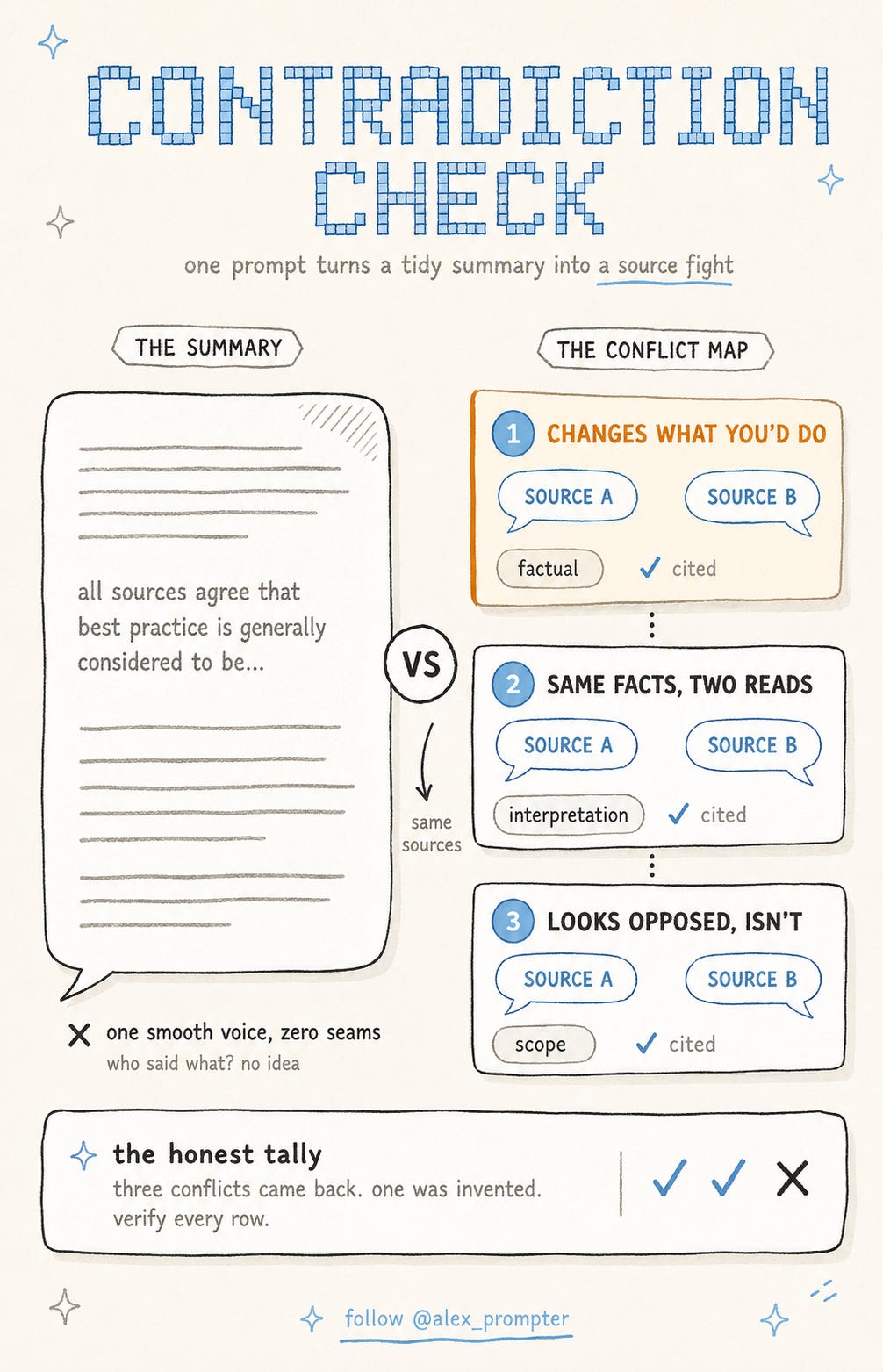
So I picked three documents that should agree and mostly don’t: the current official prompting guides from Anthropic, Google, and OpenAI. Three companies explaining how to talk to their own models.
⚙️ THE WORKFLOW
Getting the sources in is the part nobody writes about, so I’ll go first. Pasting the URLs failed. All three are JavaScript-heavy doc sites, and two of them imported as navigation menus, a list of links where the guide should have been. Nothing errors, which is the dangerous bit: the notebook carries on answering from whatever it grabbed.
The fix took a while to find. Most doc sites publish a clean text copy of themselves for this reason. Anthropic’s has a “Copy page” button, and adding .md to the URL works too. Google’s docs take .md.txt on the end. Paste each into a text file, upload all three, and you’re working from the real guides.
Then verify, before you ask anything else:
For each of my sources, give me the title as it appears, roughly how many
sections it contains, and the first sentence of the main body. Then tell me
whether any source looks like only a navigation list rather than full article text.
If a source answers with link text or a short section count, rebuild it. A notebook holding one real document and two hollow ones doesn’t warn you; it writes the same confident answer either way.
Once all three check out, paste this:
You have my sources loaded. Answer only from them. If something isn't in the
sources, say so instead of filling the gap.

My question: [YOUR QUESTION]

Don't summarize. Split your answer into four parts.

PART 1: DIRECT CONFLICTS
Only include items where two or more sources take a position on the same
question and those positions differ. Silence is not disagreement: if a source
doesn't cover something, that belongs in Part 2 or Part 4, never here.
For each:
1. THE QUESTION at stake, in one plain sentence
2. WHO SAYS WHAT, naming each source and its position, with a citation
3. TYPE: factual conflict (they can't both be right), interpretation conflict
   (same evidence, different read), or scope conflict (they look opposed but
   describe different situations)
4. WHAT WOULD SETTLE IT: the specific test, number, or document that resolves it
5. DOES IT MATTER: would resolving this change what I'd actually do?

Sort so the ones that change my decision come first.

PART 2: ONLY ONE SOURCE SAYS THIS
Maximum 5 items, and only ones that would change what I do. Cite each.

PART 3: AGREED
What all sources agree on. 3 bullets max.

PART 4: BLIND SPOT
What none of them cover that this question needs.

Cite everything. If the sources are too thin to answer, say so instead of guessing.
Ask a general question, and you get forty rows of “only this source mentions X,” which is coverage difference wearing a conflict costume. Splitting the answer into four parts fixes that. Part 1 holds the head-to-head fights, and capping Part 2 stops them flooding it.
The results came back messier than a clean win, and more useful.
It returned 3 direct conflicts. The first was real: Google recommends always including few-shot examples, meaning worked examples of the task inside your prompt, while OpenAI reports better scores from stripping prompts down. I’d never have caught that reading all three back to back.
It invented the second one. It claimed Anthropic and Google disagree about where instructions go in a long prompt. They don’t. Anthropic says put the documents at the top with your question below them; Google says context first and instructions at the very end. That’s the same instruction described from two angles, and it ranked second out of three.
It also miscredited XML tags as Anthropic-only, when Google’s guide recommends them by name and includes a template. And it pinned a 10 to 15% improvement figure on dropping examples, when the source credits that gain to leaner prompts overall. It missed at least three real conflicts in those same files, including one lab contradicting itself on a single page.
Of three headline findings, one was fake, and one carried a broken number. Six free queries and 10 minutes for two solid leads, plus a fake I had to catch.
The honest verdict is that this generates leads you then go and check. Treat every row as a claim, including the order they arrive in, because the invented conflict placed above a real one. It also reads length as significance: feed it three files of different sizes and it’ll tell you the small one had less to say.
Want the version that catches more? Run it twice with the source order reversed. Anything surviving both passes is probably solid; anything appearing once is where I’d start.
💬 PROMPT OF THE DAY
Give me your recommendation. Then tell me what would have to be true for this
to be the wrong call, and what I should check in 30 days to find out.
Why it works: it forces the model to name its own failure conditions and attach a date to them, so the advice arrives with an expiry instead of sounding permanently true.
Best on: any model.
📚 USEFUL RESOURCES
📓 Gemini Notebook (formerly NotebookLM, source-grounded research) → the free tier covers today’s workflow: 100 notebooks, 50 sources each, 50 chats a day (free: notebooklm.google.com)
🟠 Anthropic’s prompting best practices (official Claude guide) → the deepest of the three, and “Copy page” saves you the import fight (free: platform.claude.com/docs/en/build-with-claude/prompt-engineering/claude-prompting-best-practices)
🔵 Google’s prompt design strategies (official Gemini API guide) → built around worked examples rather than rules, so read it for the tables (free: ai.google.dev/gemini-api/docs/prompting-strategies)
⚫ OpenAI’s model guidance (official GPT-5.6 guide) → shortest of the three; the leaner-prompts section is the part worth your time (free: developers.openai.com/api/docs/guides/latest-model)
📌 Top 16 NotebookLM prompts (the viral list, 13K bookmarks) → #11 planted the seed for today’s superpower; written pre-rename, so a few may have aged: x.com/alex_prompter/status/2008938090950475816)
What should I break down next: a Claude skill that reviews your work before you ship it, or an automation that runs while you sleep? Hit reply, one word is enough.
Know someone who learns everything from a single chat window? Forward them this.
And as always, remember: LLMs don’t think, you do.
⚡ Alex Prompter
P.S. Today’s Contradiction Check is one prompt. My Claude Skills Bundle turns Claude into 20+ specialists for marketing and business. Grab yours here: linktr.ee/alex_prompter