

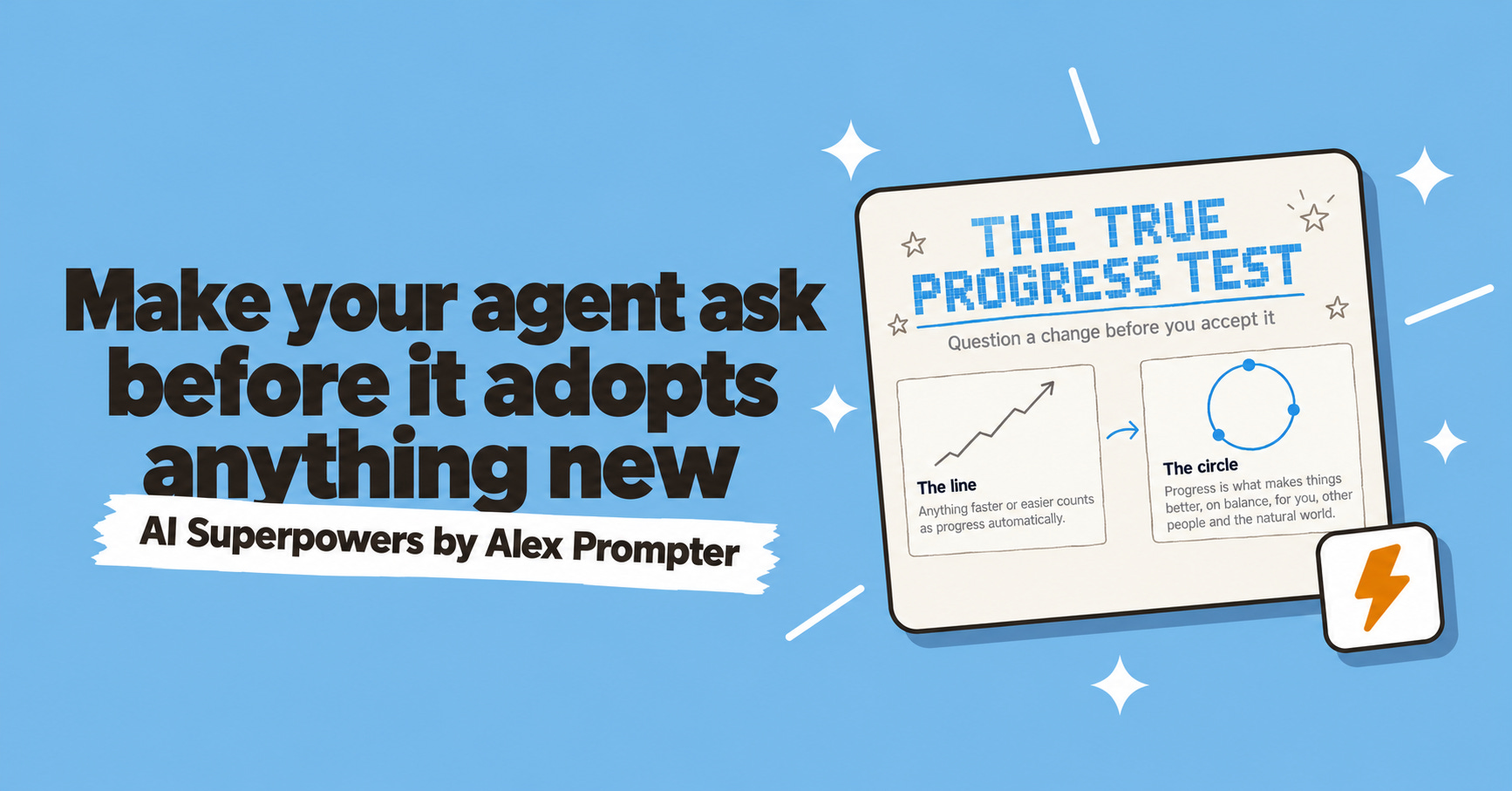
Read time: 5 minutes | Unlock my Claude Skills Bundle
Hey friend, Alex here.
I’ve been thinking about a question lately: if an AI tool makes something easier, does that automatically count as progress? Last week’s news made me think about it again. Agents were handling everyday errands, and much of the attention was on what they could do, rather than whether the benefits were worth the trade-offs.
We tend to treat every new AI capability as an improvement. But making something easier doesn’t tell you what it costs, who takes on the risk, or what happens if it goes wrong. It’s worth asking those questions before giving an agent access to your accounts or payment details.
Today:
What happened when AI agents started handling everyday tasks, and which questions got overlooked
The True Progress Test, a free rulebook you can add to your agent’s instructions so it checks before adopting something new
Four useful links, including a 1998 talk that still makes a strong case for questioning new technology
📰 WHAT HAPPENED LAST WEEK
At the start of the week, Andrej Karpathy described what he called a sharp funnel of AI experience. About 6 billion people have barely touched AI, while a few thousand insiders are running large fleets of agents. Seeing that comparison, it’s easy to feel as though you’re falling behind.
By Wednesday and Thursday, agents were handling shopping tasks. A Google engineer posted that one of his agents only handles Amazon returns. Grok Bot users then started seeing a block screen on Amazon saying that continued access by an unauthorized AI agent violates Amazon’s Conditions of Use. Elon Musk told people to shop somewhere else, then posted this.


Hours earlier, Musk had promised that SpaceX would make users whole if Grok Bot botched a purchase or leaked a card. But Teslarati noted that Grok Bot’s consumer terms still make users responsible for what their agents do and generally cap liability at the greater of fees paid or $100. Amazon’s terms require agents to identify themselves, and Amazon hasn’t commented on the Grok Bot block.
By the end of the week, OpenCode, an open-source coding agent, had disclosed a breach affecting 1.4% of its Console users who had connected their own OpenAI, Anthropic, or Google API keys. Some reported around $1,700 in unauthorized charges overnight.

Reading these stories, I kept coming back to the same question: is the benefit worth the trade-offs? An agent handling your shopping saves you time, but it also needs access to your payment details. If something goes wrong, a promise in a social post isn’t the same as protection in the written terms, especially when those terms limit liability. The retailer also has a stake in how its site is accessed. I don’t have numbers for the impact on the natural world, so I’d mark that as “unknown” rather than guess. Convenience matters, but it shouldn’t be the only thing we measure.
My recommendation is to put these questions in your agent’s standing instructions before giving it permission to act on your behalf. If you use Grok Bot, which featured prominently in this week’s news, that’s where I’d start.
⚡ THE SUPERPOWER: The True Progress Test
I worked through these questions myself for one story. But if your agent is connecting new tools or signing up for services, it makes sense to have the agent ask before doing those things. Otherwise, you’re reviewing the decision after the setup has already happened.
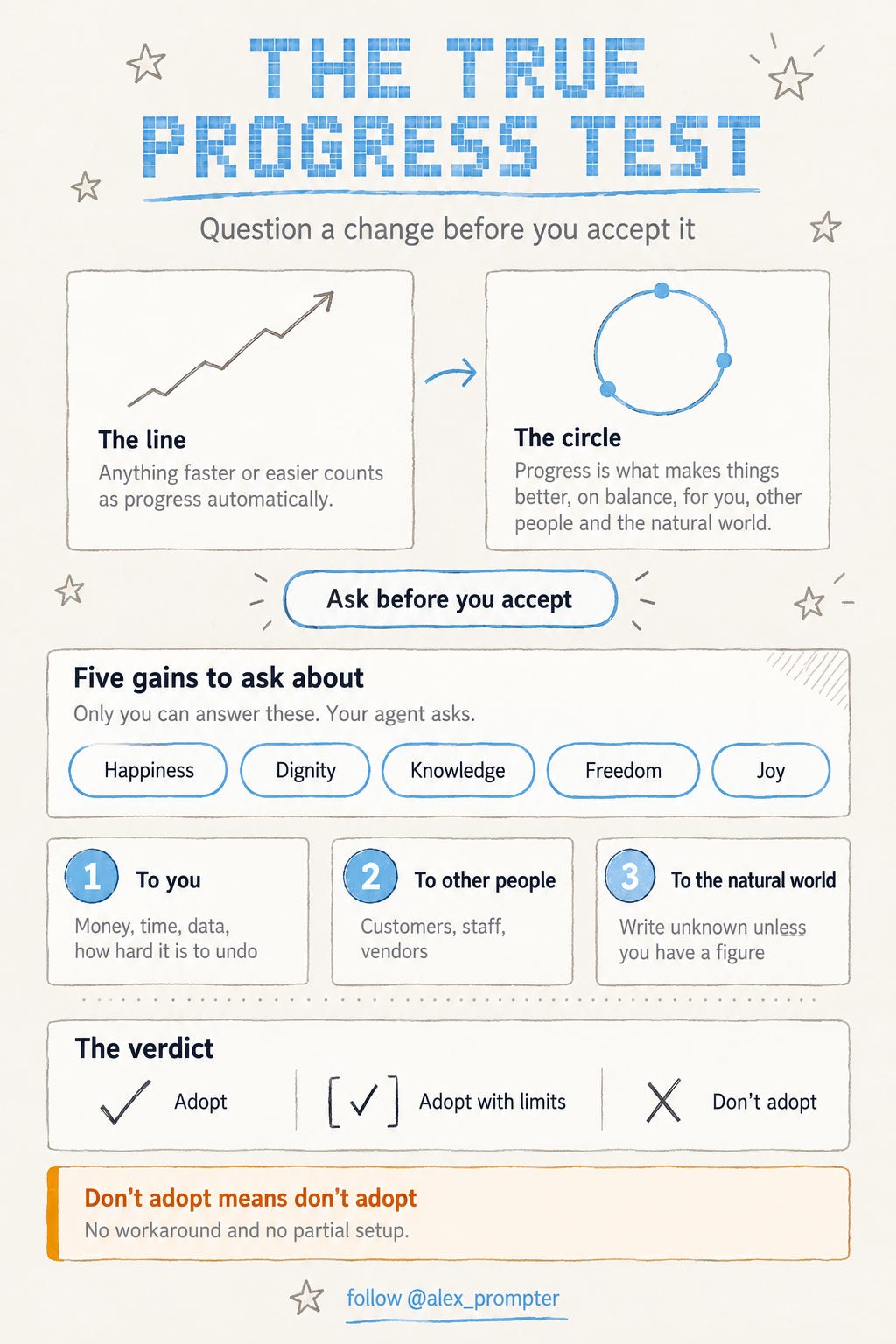
I think we need a broader way to judge progress. Something being faster or easier is useful, but that doesn’t automatically make it better. I also want to know whether it improves happiness, dignity, knowledge, freedom, or joy, and what it costs me, other people, and the natural world. If the downsides outweigh the benefits, an impressive demo isn’t a good enough reason to adopt it.
⚙️ THE WORKFLOW
So I put the questions into a short rulebook called progress-test.md. The idea is for your agent to read it before adding a new tool, integration, automation, or vendor to anything you run. Substack can’t host .md files, so I’m sharing it as a free PDF with the full rulebook and instructions for creating the file. An agent with file access can save it for you; a chat assistant can give you the text to paste into your project instructions.
Once it’s installed, the agent pauses before a new setup. It explains the proposed change in plain language, asks whether it would bring you more happiness, dignity, knowledge, freedom, or joy, and reviews the costs to you, other people, and the natural world. It marks the environmental impact as “unknown” unless you provide a figure. Then it recommends one of three options: adopt, adopt with specific limits, or don’t adopt. “Don’t adopt” means no workaround and no partial setup.

Send the PDF with this message:
Turn the attached PDF into a file called progress-test.md, exactly as written on its rulebook page. Save it wherever you keep your standing instructions, and follow it from now on whenever you're about to add a new tool, integration, automation, or vendor. Tell me where you saved it.To set it up and check that it’s working, follow these four steps:
Send the PDF and the message above. In Grok Bot, ask it to save the rulebook as a skill. In Claude Code, save the file in your project and add
@progress-test.mdtoCLAUDE.md. Claude Code readsCLAUDE.md, not other agents’ rules files.Check the file. Ask the agent to show you where it saved the rulebook. If it can’t, paste the text into your project instructions yourself.
Try a real example. Ask it to set up something you’ve been meaning to add. It should pause and ask for your input before starting.
Make the decision yourself. Answer the questions about the benefits, review the costs, then consider the verdict.
Treat this version as something you can adjust. An agent can’t judge your happiness or dignity for you; it can only ask, and the recommendation depends on your answers. It will often return “unknown” for the natural-world impact rather than invent a number. The check also adds a step to new setups, which is why it skips routine work inside tools you’ve already approved.
💬 PROMPT OF THE DAY
Here's the agenda for my next meeting. Tell me the one decision this meeting has to produce, and the one question I should ask in the first five minutes to get there.
Why it works: Starting with the decision makes it easier to see which agenda items deserve time and which won’t help the meeting move forward.
Best on: any model.
📚 USEFUL RESOURCES
🎙️ Five Things We Need to Know About Technological Change (Neil Postman’s 1998 talk) → his first idea is that every technological change is a trade-off, and he asks who benefits from each one (free)
📕 Why I Am Not Going to Buy a Computer (Wendell Berry’s essay, now a short book) → Berry sets the standards a new tool has to meet before he’ll use it ($, bookstores)
📖 How Claude Code loads CLAUDE.md (official docs) → explains the @ import line from step 1 (free)
🛒 Amazon’s Conditions of Use, Agents section (Amazon’s rules for AI agents) → useful if you sell online or use agents that access the site (free)
What should I build next: a rulebook that makes your agent ask before it spends money, or one that asks before it emails someone for you? Reply with “money” or “email.”
Know someone who tries every new AI tool as soon as it comes out? Feel free to forward this issue to them.
And as always, remember: LLMs don’t think, you do.
⚡ Alex Prompter
P.S. The True Progress Test is one rulebook. My Claude Skills Bundle turns Claude into 20+ specialists for marketing and business. You can run that through the same test before deciding whether you need it. Get it here: https://linktr.ee/alex_prompter
AI Superpowers, part of the Alex Prompter network. One new AI superpower every Tuesday, under 5 minutes.