

Read time: 5 minutes | Unlock my Claude Skills Bundle
Hey friend, Alex here.
On Thursday, OpenAI posted a sentence that 132 million people have now seen. “Anything you can do on a computer, Astra can do for you. Fast.”


Four days later, one of the people building Codex at OpenAI announced a global usage reset for every paid subscription, because subscribers had burned through their whole allowance doing 3D modeling in Blender before the work week had even started.

That launch sentence is first-order thinking on a planetary scale. Something new shows up, you see the obvious consequence, and you act on it in the same breath. The reset is what it looks like when nobody asks the next question. The two loudest reactions in my feed this week were “upgrade now” and “it’s all hype,” and both of them stop at the first consequence. Nobody in either camp asked what happens after that.
Today:
The prompt that walks any decision two consequences deep on both the yes branch and the no branch, copy-paste ready
My honest run on the one Astra decision I had to make this week, with the real constraints attached
4 resources worth saving, including the Howard Marks memo that started all of this
⚡ THE SUPERPOWER: The Second-Order Ripple Map
I had my own version of the launch-day reflex. A client task landed that needs Astra and nothing else will do, and my first thought was to upgrade, run it, and move on. That thought took about four seconds. Howard Marks, who coined the idea in his 2011 book The Most Important Thing, describes that speed in one line. First-level thinking, he wrote, is simplistic and superficial, and just about everyone can do it.
Now look at the first-order version of this launch from the very top. OpenAI’s chief scientist, Jakub Pachocki, published an essay on Saturday in which he wrote that their ability to rely on reading the model’s written reasoning is “progressively diminishing.” The company selling the model is telling you, in writing, that the widest ring of this launch is one it can’t see the edge of yet. If OpenAI is asking “and then what?” about its own product, you and I can afford to ask it about a subscription.
The picture I keep coming back to is a stone in a pond. The splash is the part everyone sees, and it's also the part you wanted when you picked up the stone. The rings are the consequences you didn't choose but will live with anyway. The first consequence of any decision is the one you were hoping for. The second consequence decides whether the decision was any good.
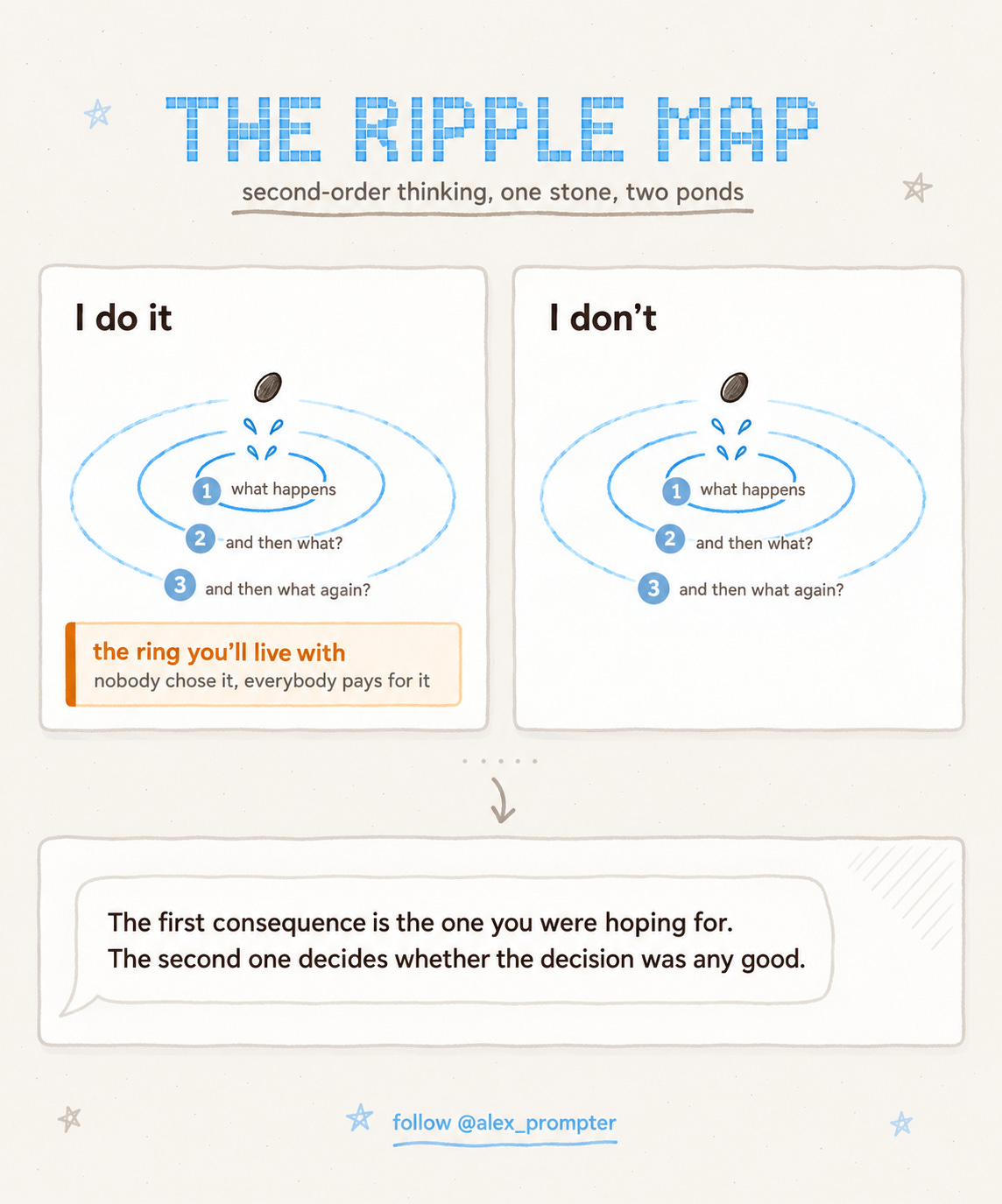
When I ran my own decision through it, the map spent one sentence on the $20 and the rest on two costs I had never written down anywhere.
⚙️ THE WORKFLOW
So before I hit upgrade, I made Claude walk the rings for me. I gave it the decision with the real constraints attached and asked it to follow both branches, the yes and the no, two consequences deep on each. Then it had to name the consequence I was least ready for on each side, and hand me one thing to watch over the next 30 days that would tell me which branch was winning.
Open a fresh Claude chat. The free tier handles this fine, and I ran mine on Claude Fable 5.1. Paste this, then describe your decision underneath it in two or three plain sentences.
I'm about to make a decision. I'll describe it below with the real constraints attached (money, time, people, deadlines).

Walk it as a ripple map.

Branch A is "I do it." Branch B is "I don't."

For each branch, give me three rings.
1. First ring. What happens right away if I take this branch? One or two sentences.
2. Second ring. And then what? What does the first ring cause over the next few weeks?
3. Third ring. And then what again? What does the second ring cause over the next few months?

After both branches, name the single consequence on each side that I'm least prepared for, and say why you think I haven't priced it in.

Then give me one signal I can watch over the next 30 days that would tell me which branch is winning. Make it something I could observe, with a number attached if possible.

Rules. Use only the constraints I gave you. If you need to assume something, label it as an assumption. Don't tell me which branch to pick.

My decision is below.
Four things separate a real map from a pretty one.
Describe the decision with numbers attached. “Upgrade to Plus for a client task” is a splash. “Upgrade to Plus at [price] a month for a client task due [day] that needs computer use, while I already pay for another AI subscription” is a stone with real weight, and the heavier the stone, the more real the rings come back.
Read the second ring before the first. The first ring is the part you knew before you opened the chat. The second ring is where the prompt earns its keep.
Argue with the “least prepared for” line. If it’s wrong, write down why. If you can’t write down why, you have your answer.
Put the 30-day signal in your calendar. Second-order thinking only works if you come back and check whether the rings showed up.
I ran it once. I typed my real decision under the prompt in four sentences and let Claude go. It came back with three rings for “upgrade” and three for “don’t,” and it flagged two things it was assuming along the way. One of them was whether Plus even includes Astra. It does, I checked, but I should have thought of that before Claude did.
On the upgrade side, the cost it said I hadn’t thought about was time. Two tools open every day means hours lost to switching, re-explaining, and re-prompting. None of that shows up on a bill, which is why it never showed up in my thinking.
On the skip side, it asked a question I had walked right past. Does the client need Astra, or does the client believe they need it? I had planned for losing the task.
I hadn’t planned for that conversation. Then it gave me one thing to count over the next 30 days. How many clients name a specific model as a must-have? Zero or one, and the “don’t” side is right. Three or more, and clients now expect me to have it. One decision, one run, so take this as a lean and not a law.
Fair warning. The third ring is a guess built on a guess, and Claude said as much when it flagged a “fourth launch” as an assumption. Act on ring two and read ring three as a direction only. The prompt also walks just two branches, so if your decision has five options, pick the two you’d take and paste those.
Want Claude to do this on every decision without pasting the prompt each time? The six-page guide that installs it as a permanent skill is at the bottom of this email.
💬 PROMPT OF THE DAY
Rewrite this message so the reader can say no to it without feeling bad, and without me looking like I expected a yes.Why it works: it strips out the pressure language and implied obligation that make people ghost instead of replying.
Best on: any model.
📚 USEFUL RESOURCES
📝 Howard Marks, “It’s Not Supposed to Be Easy” (the second-level thinking memo) → from the man who coined the term, written for investors but the questions work on any decision (free: https://www.oaktreecapital.com/insights/memo/its-not-supposed-to-be-easy)
🧠 Farnam Street on second-order thinking (the “and then what?” explainer) → the clearest short read on the model, with examples outside finance (free: https://fs.blog/second-order-thinking/)
🤖 GPT-6 Astra (OpenAI’s launch page) → worth a test on computer-use tasks, and read the usage limits for your plan before you upgrade (paid plans: https://openai.com/index/gpt-6-astra/)
🔬 Jakub Pachocki, “An Alien Mind” (OpenAI chief scientist’s essay) → the source of today’s “progressively diminishing” line, read it before you hand a decision to the model (free: An Alien Mind | OpenAI)
Next real run, Incentives (who benefits if you believe this advice) or Probabilistic Thinking (how to decide before you’re sure)? Hit reply, one word is enough.
Know someone who upgraded on launch day and hasn’t asked “and then what?” yet? Forward them this.
And as always, remember: LLMs don’t think, you do.
⚡ Alex Prompter
P.S. Today’s Ripple Map is one prompt. My Claude Skills Bundle turns Claude into 20+ specialists for marketing and business. Grab yours at linktr.ee/alex_prompter
AI Superpowers, part of the Alex Prompter network. One new AI superpower every Tuesday, under 5 minutes.