

Read time: 4 minutes | Unlock my Claude Skills Bundle
Hey friend, Alex here.
Anthropic just published how Claude’s invisible watermark works. A secret key nudges Claude’s word choices into a statistical pattern that you can’t see, but anyone holding the key can check that it’s the same SynthID method Google uses for Gemini. Buried in the explainer is the sentence almost nobody quoted. A detected mark means the text passed through Claude, and it says nothing about who wrote it.
Sit with that gap for a second. The detection industry can now prove a machine touched your document, and not one tool in that stack can prove you did. Your ideas, your direction, the 40 minutes you argued with Claude about the third paragraph leave no trace in the file. The watermark has receipts, and you don’t.
Today:
A session-start prompt that makes Claude keep an honest authorship record while you write, tagging every passage as yours, Claude’s, or in between
A PDF you can feed straight to Claude to build the permanent skill version, one upload, no coding
4 free resources for owning your work, including Grammarly’s Authorship feature and Anthropic’s own explainer
⚡ THE SUPERPOWER: The Authorship Report
Last thing you want after shipping a piece you sweated over is a client or professor running it through a detector, watching the needle jump, and handing you the burden of proof. You know the split. Maybe 60% of the words are yours, the structure is Claude’s, the argument was yours before either of you typed. But the finished file is flat. It looks the same whether you drove the work or ordered it like takeout.
Illustrators solved this two years ago when the “that’s AI” mobs came for hand-drawn art. They didn’t argue with accusers. They hit record and let the timelapse answer. The proof of authorship was never in the finished image; it lives in the process, and the process disappears unless someone is keeping the record while it happens.
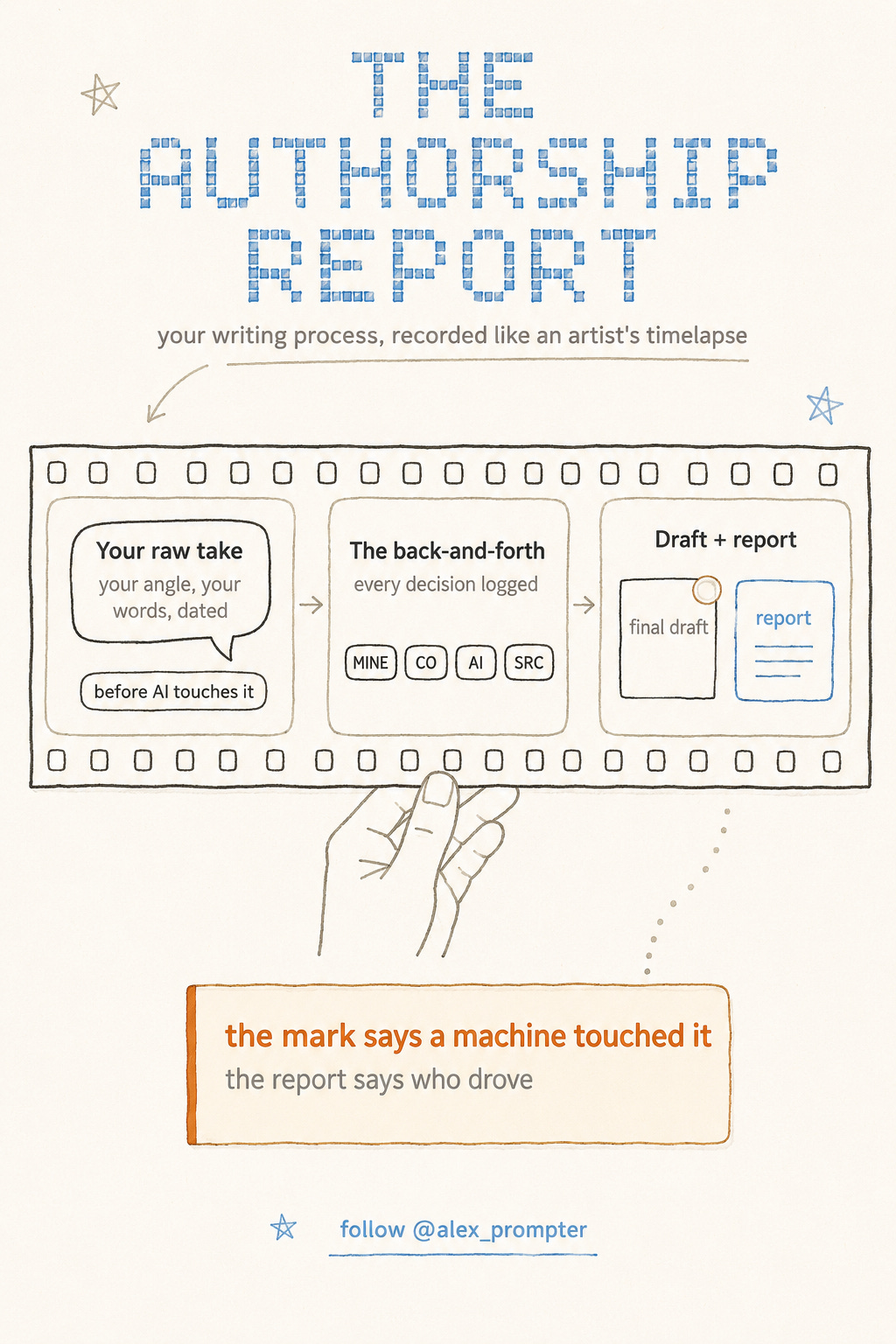
The prompt below turns that idea into a habit, and by the end of your next piece you'll know your own split in numbers instead of vibes.
⚙️ THE WORKFLOW
So I wrote a prompt that turns Claude into the camera. You paste it at the top of the session, before any writing starts, and from that moment Claude keeps the record of what you brought, what it drafted, and what you overruled.
Open a chat (free tier works, though a Project keeps your reports in one place) and paste this before anything else:
You are keeping a live authorship record for everything we
write in this session.

Before we start:
1. Ask me for my raw take first: my angle, my examples, my
   opinion, in my own messy words. Wait for it. Save it
   verbatim with today's date. That is the before-AI record.

While we work:
2. Track the origin of every passage in the draft using four
   tags: [MINE] my words kept mostly intact, [CO] my idea,
   your phrasing, [AI] you drafted it and I accepted it,
   [SRC] brought in from an outside source I named.
3. Log each round in one line: what I asked, what changed,
   what I rejected.

When I say "authorship report":
4. Output one clean report: the dated before-AI record on
   top, the draft with origin tags, a percentage breakdown
   by tag, and a one-paragraph honest summary of how involved
   I actually was, including where I just accepted your first
   suggestion without pushing back.

Be accurate over flattering. If I barely steered, the report
says so.
Then write the way you always do. When the piece is done, say “authorship report” and save what comes back next to the final draft. That’s the reel you pull out when someone asks the question.
The teeth are in that last instruction. A record that only ever says “deeply involved” is worthless, so the report has to be believable before it can be flattering. If you phoned the piece in, your report will say so, and that honesty is what makes the involved ones carry weight.
There’s no A/B to run on this one, and forcing one wouldn’t tell you anything. A record either exists when the question comes or it doesn’t. The test that matters is whether process records hold up as proof in the real world, and that evidence is already in.
Artists post work-in-progress timelapses to kill AI accusations. Grammarly built a whole feature on the same idea, tracking origin while you type and exporting a shareable report. And Anthropic’s own explainer says in plain words that the watermark can’t establish authorship. The record you keep is the only thing that can speak for your half.
Fair warning: this report is testimony, not forensics. It’s Claude’s account of one chat, it can’t see the work you did outside that chat, and someone determined could stage one. Its credibility comes from keeping it as you go, piece after piece, long before anyone asks. Save it for work where your name carries weight and skip it for throwaway emails. And no, it doesn’t touch the watermark. The mark will keep saying a machine was here, and your report says who was driving.
Want this running permanently instead of pasting the prompt each time? I packaged the full build instructions into the PDF attached below. Upload it to Claude, say “build this skill,” and Claude constructs the always-on version inside a Project. Same tracking, same report, and nothing to paste ever again.

💬 PROMPT OF THE DAY
Read this draft as the most skeptical person who will receive it. List the three objections they'll raise, ranked by how likely they are, and quote the exact line that triggers each one.Why it works: assigning a hostile reader flips the model from praising your draft to stress-testing it, and the quoted lines show you exactly where to edit.
Best on: any model.
📚 USEFUL RESOURCES
📄 Anthropic’s watermark explainer (how the mark really works) → the primary source behind today’s issue, including the “processed, not authored” line most coverage skipped (free: anthropic.com/news/claude-text-watermark)
✍️ Grammarly Authorship (the commercial cousin of today’s build) → records your writing process in Google Docs or Word and exports a shareable report; a whole different workflow from writing in Claude, worth knowing it exists (free tier: grammarly.com/authorship)
🔖 Content Credentials (provenance you can verify) → attach a signed, tamper-evident history to files, and check anyone’s at contentcredentials.org/verify (free: contentcredentials.org)
🗄️ Obsidian (local vault for your reports) → keep every authorship report as plain files you own, not locked in someone’s cloud (free for personal use: obsidian.md)
What’s a workflow you wish you could hand to Claude and trust it got done right? Hit reply and tell me in one line.
Know someone scared of getting false-flagged for work they did? Forward them this.
And as always, remember: LLMs don’t think, you do.
⚡ Alex Prompter
P.S. Today’s authorship report is one prompt, and the PDF turns it into one skill. My Claude Skills Bundle installs 20+ more, each one turning Claude into a different specialist for marketing and business. Grab yours in one click: linktr.ee/alex_prompter
AI Superpowers, part of the Alex Prompter network. One new AI superpower every Tuesday, under 5 minutes.