

Read time: 4 minutes | Unlock my Claude Skills Bundle
Hey friend, Alex here.
Last Wednesday a friend messaged me: “Can you help me set up Claude Cowork? 20 minutes, tops.” I said yes before I finished reading. Three hours later I was still on the call, teaching him how to write context, why “make it better” gets you nothing, and what a finished result should look like before you ask for one. He left happy, and I finished a client proposal at 1 AM.
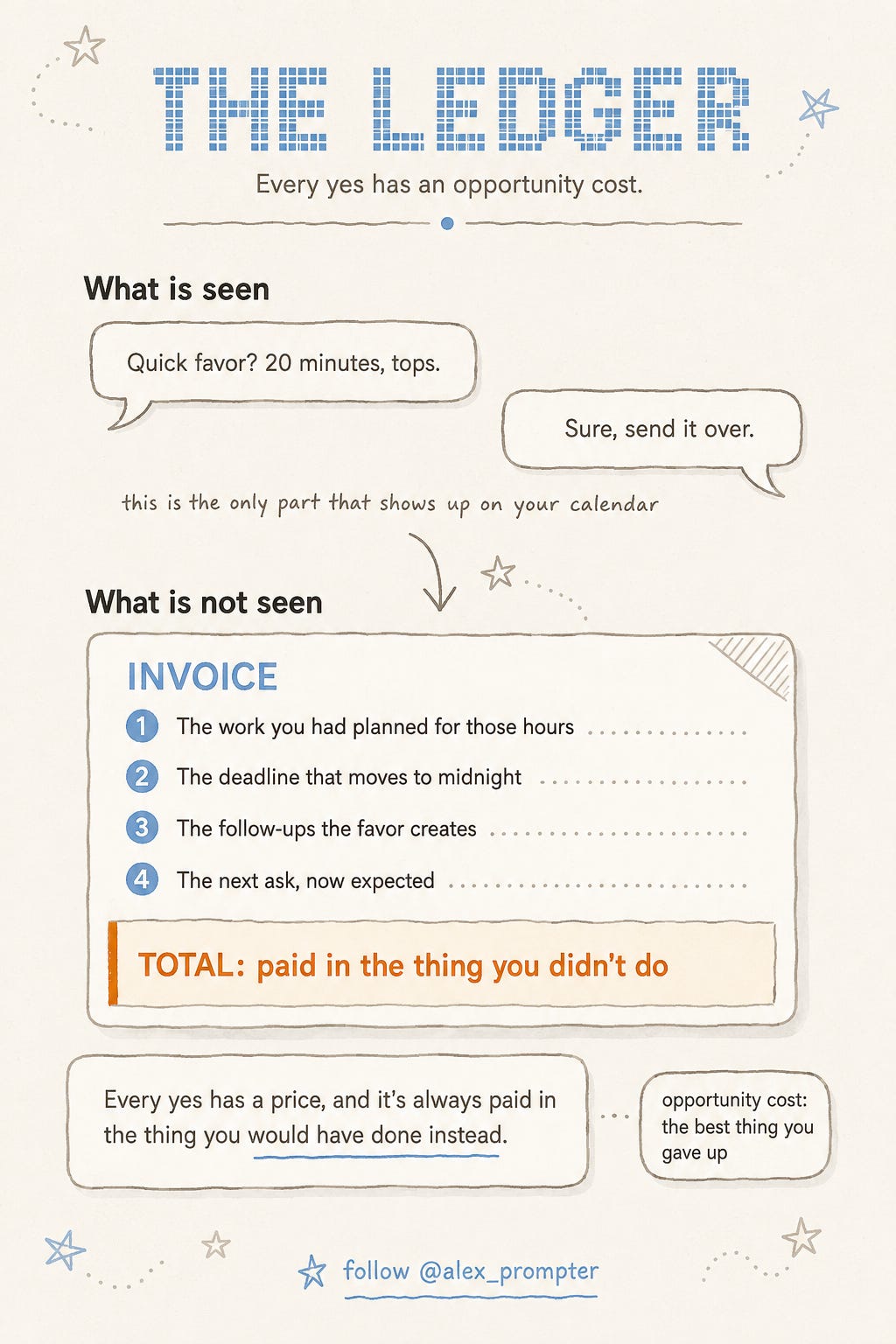
Nobody sent me an invoice for those 3 hours, so the yes felt free, and the proposal paid for it. That’s how most of us run a calendar: we price the ask (20 minutes, sounds fine) and we never price what the ask replaces.
Today:
The prompt that turns any yes you’re about to give into an itemized invoice of what it displaces, in hours and money (copy-paste ready)
One real run: a florist client’s “nothing too elaborate” wedding favor through the prompt, and the $910 invoice that came back
3 free resources, including the 1850 essay this whole idea comes from
⚡ THE SUPERPOWER: The Opportunity Cost Ledger
You already know the “20 minutes” is a lie. The strange part is that the lie survives contact with your own calendar. The call shows up as a block; the proposal you didn’t write shows up nowhere. So you keep saying yes to quick reviews, short calls, and “can you take a look,” and the bill for each one lands on a different day, under a different name.
Every yes has a price, and it’s always paid in the thing you would have done instead. Economists have a name for this: opportunity cost. The Austrian economist Friedrich von Wieser gave it that name in 1914, and Frédéric Bastiat had already drawn the picture in 1850 with a pamphlet called What Is Seen and What Is Not Seen. The yes is seen; the 1 AM proposal is not.
The first real run I saw was a florist pricing a favor the asker had called "nothing too elaborate." The invoice came back at 14 hours, against the 6 free hours she had that week.
⚙️ THE WORKFLOW
So I built the accountant I never hired. You hand it the yes you’re about to give, plus what your time is worth and what you’re supposed to be working on this month, and it hands back the invoice.
Open a fresh chat in Claude or ChatGPT (free tiers work) and paste this:
You are my opportunity cost accountant. I'm about to say yes to something. Your job is to show me the invoice I would never see.

Here's the commitment, exactly as it was asked of me:
[PASTE THE ASK]

Context about me:
- Role: [e.g. founder of a 6-person marketing agency]
- What I'm supposed to be working on this month, ranked: [1. ... 2. ... 3. ...]
- What one hour of my work is worth: [e.g. €80, or "one client email sequence per 2 hours"]
- How much free time I have this week: [e.g. 4 hours]

Do this in order:
1. Estimate how long the commitment will really take, including prep, follow-up, and the interruptions it causes. If the ask says "20 minutes," assume that's wrong and say by how much.
2. Build the ledger. List what those hours displace from my ranked list above, one line each, with hours and money on every line. Put a total at the bottom.
3. Name the costs money doesn't capture: momentum lost, a deadline pushed, the relationship cost of saying no.
4. Give me the cheapest version of yes: the smallest thing I could offer that keeps most of the value for them at a fraction of the cost to me.
5. One-line verdict: take it, take the cheap version, or decline. Then stop.

Rules: use my numbers, not generic ones. If you're guessing at a duration, say so and give a range. Don't reassure me. Don't pad.
Then work it like this:
Paste the ask word for word. “Quick call to pick your brain” tells the prompt more than your polite summary of it.
Fill the context block for real. The ranked list is the part that makes the ledger honest. If you list nothing worth displacing, the prompt can’t find a cost, and it will tell you so. If you already know the sub-tasks, add them to step 1 of the prompt, and the estimate gets sharper.
Read the ledger before the verdict. The lines are the point; the verdict is a cover page.
Push on step 4. Ask: “What if I only had 30 minutes?” The cheapest version of yes is where this prompt pays for itself. For my Cowork friend, it would have been a 15-minute screen recording and a link to my prompting notes.
The florist is a client of mine who runs a shop with 5 employees. The ask was a wedding as a favor: bouquet, table arrangements, ceremony flowers, and a Saturday setup at the venue. She pasted the message into ChatGPT with her own numbers and her four ranked goals for the month, and added her own task list to step 1.
The invoice came back at 14 hours, give or take two. At $65 an hour she puts on her time, that’s $910, in a week where she had 6 hours free. Almost half of those hours would have come straight out of her top goal, booking paid weddings. The cheapest version of yes was one bouquet, charged, made by her staff, pickup only, which brought her own time down to under 3 hours. The verdict is to take the cheap version. That’s one yes in one shop, so read it as the ledger in practice, not a benchmark.
Fair warning. This hourly rate is a rough proxy for most of us, so the $910 is only as solid as the $65 behind it. And the neat split of hours across her four goals is the model guessing in table form. Trust the total, not the rows.
There’s a skill version too. It takes your whole week of yeses in one paste and tells you which three to renegotiate first. The PDF that builds it is right below, for paid subscribers.
💬 PROMPT OF THE DAY
Translate this message into what the sender would say to a friend over a beer. Keep the meaning, drop every softener and hedge, and end with one line naming what they want from me or what they're worried about.Why it works: corporate register exists to hide intent and stakes behind hedges; strip the hedges and both come to the surface.
Best on: any model.
📚 USEFUL RESOURCES
📜 Bastiat, What Is Seen and What Is Not Seen (1850 pamphlet, the origin) → the broken-window story in the first chapter is the whole idea; you can stop there (free: https://fee.org/resources/that-which-is-seen-and-that-which-is-not-seen/)
🧭 Farnam Street, “Tradeoffs: The Currency of Decision Making” (mental-models essay) → the practical version, how to budget your yeses across a week (free: https://fs.blog/tradeoffs-decision-making/)
🎓 Two Cents (PBS), “The Hidden Costs of Every Decision You Make” (6-minute YouTube explainer) → opportunity cost told through a concert ticket, a college loan, and a bottle of wine; the friendliest version of today’s idea (free: here)
Hit reply with one of two things: a philosophy or mental model you live by that you’d like turned into a prompt or skill, or a tool you use every day that deserves a proper workflow. One line is enough.
Know someone whose calendar is full of other people’s 20-minute favors? Forward them this.
And as always, remember: LLMs don’t think, you do.
⚡ Alex Prompter
P.S. Today’s Opportunity Cost Ledger is one prompt. My Claude Skills Bundle has 20+ skills, each one turning Claude into a different specialist for marketing and business. Grab yours here: https://linktr.ee/alex_prompter
AI Superpowers, part of the Alex Prompter network. One new AI superpower every Tuesday, under 5 minutes.